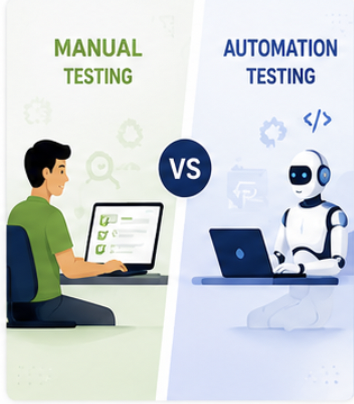
Manual Testing vs Automation Testing: Which is Better for Your Business?
Software quality is one of the most critical factors for the success of any application. Whether you are developing a web application, mobile app, SaaS platform, or enterprise software, testing plays a vital role in ensuring reliability, performance, and user satisfaction.
Two of the most common software testing approaches are Manual Testing and Automation Testing. While both methods help identify defects and improve software quality, they serve different purposes and offer unique advantages.
In this article, we’ll compare Manual Testing vs Automation Testing and help you determine the best approach for your business.
What is Manual Testing?
Manual Testing is a software testing process where QA engineers execute test cases manually without using automated scripts or tools.
Testers interact with the application as real users, verifying functionality, usability, workflows, and overall user experience.
Manual testing is commonly used for:
- Functional Testing
- Exploratory Testing
- Usability Testing
- User Acceptance Testing (UAT)
- Ad-Hoc Testing
Advantages of Manual Testing
- Human observation and judgment
- Better user experience evaluation
- Flexible and adaptable testing process
- Ideal for small projects and changing requirements
- Lower initial investment
Limitations of Manual Testing
- Time-consuming for repetitive tasks
- Less efficient for large-scale testing
- Higher risk of human error
- Difficult to execute thousands of test cases repeatedly
What is Automation Testing?
Automation Testing uses scripts, frameworks, and tools to execute test cases automatically.
Instead of manually repeating the same tests, automated scripts validate application functionality, performance, and stability across multiple environments.
Automation testing is commonly used for:
- Regression Testing
- Smoke Testing
- API Testing
- Performance Testing
- Continuous Integration and Continuous Delivery (CI/CD)
Advantages of Automation Testing
- Faster test execution
- Improved accuracy
- Better test coverage
- Supports continuous testing
- Ideal for repetitive test cases
- Long-term cost savings
Limitations of Automation Testing
- Higher initial setup cost
- Requires technical expertise
- Not suitable for all test scenarios
- Maintenance required for automated scripts
Manual Testing vs Automation Testing: Key Differences
| Feature | Manual Testing | Automation Testing |
|---|---|---|
| Execution | Performed by QA Engineers | Performed by Scripts and Tools |
| Speed | Slower | Faster |
| Accuracy | Human-dependent | Highly Accurate |
| Initial Cost | Lower | Higher |
| Maintenance | Minimal | Requires Updates |
| Best For | Usability & Exploratory Testing | Regression & Repetitive Testing |
| Scalability | Limited | Highly Scalable |
When Should You Use Manual Testing?
Manual Testing is the preferred choice when:
- Applications are in early development stages
- Requirements change frequently
- User experience evaluation is required
- Exploratory testing is needed
- Test cases are executed infrequently
Manual Testing helps identify issues that automated scripts may overlook, particularly those related to usability and customer experience.
When Should You Use Automation Testing?
Automation Testing is ideal when:
- Frequent releases occur
- Regression testing is required
- Large test suites need execution
- CI/CD pipelines are implemented
- Performance and API testing are necessary
Automation testing improves efficiency and reduces testing time significantly for repetitive tasks.
The Best Approach: Combining Both Methods
Many organizations assume they must choose between Manual Testing and Automation Testing. However, the most effective QA strategy combines both approaches.
Manual Testing provides human insight and usability validation, while Automation Testing delivers speed, consistency, and scalability.
By using both methods together, businesses can achieve:
- Faster release cycles
- Better software quality
- Improved user experience
- Reduced production defects
- Higher customer satisfaction
How Propark Softech Can Help
At Propark Softech, we provide both Manual Testing Services and Automation Testing Services to help organizations deliver reliable, high-quality software.
Our QA experts create customized testing strategies based on your project requirements, ensuring the right balance between manual and automated testing.
Whether you need exploratory testing, regression testing, API testing, mobile testing, or performance testing, our team can help you improve software quality and accelerate product delivery.
Conclusion
There is no one-size-fits-all answer in the Manual Testing vs Automation Testing debate. Both approaches offer unique advantages and play an important role in modern software quality assurance.
Manual Testing is essential for user-centric validation, while Automation Testing improves efficiency and scalability. The best results are achieved when both methods work together as part of a comprehensive QA strategy.
If you’re looking for professional QA Software testing services, Propark Softech can help you build a reliable testing process that ensures quality at every stage of development.